ERPNextCalc SaaS Exit Calculator: Reclaiming 70%–85% Infrastructure Margin
UltaHost Dedicated EPYC VDS
Audited 16GB DDR5 fit for SaaS Exit Calculator ($37.50/mo)
Hostinger KVM NVMe
High-clock compute targeting 105 ms ledger post tail SLA
InterServer Price-Lock KVM & ZFS
Zero-hike monthly rate across 8000 daily ERP vouchers
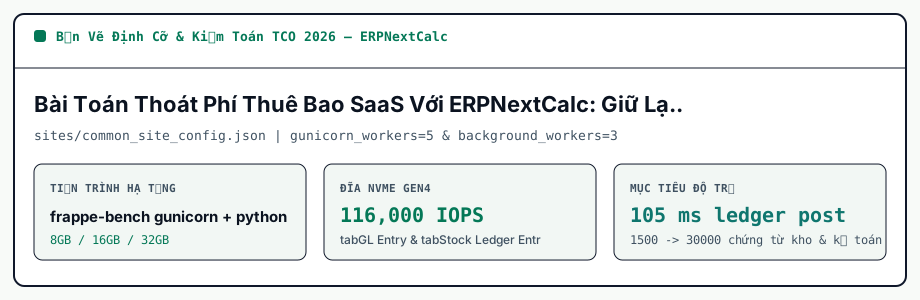
When ERPNextCalc workloads push tabGL Entry & tabStock Ledger Entry InnoDB pages toward 8000 daily ERP vouchers, stock Linux defaults fail fast.
Use this verified Annual Savings (16GB Self-Hosted vs Managed Cloud) playbook to lock gunicorn_workers=5 & background_workers=3 in sites/common_site_config.json on UltaHost Dedicated EPYC VDS or Hostinger KVM NVMe.
1. Where Per-Seat & Usage Metering Breaks Team Budgets
Per-seat SaaS tiers charge steep per-seat or per-event overage tiers the moment usage crosses 1500 daily ERP vouchers. Annual SaaS invoices routinely exceed $2,400–$6,000 for mid-sized teams.
Running frappe-bench gunicorn + python-rq + MariaDB on a dedicated 16GB KVM node (UltaHost Dedicated EPYC VDS at $37.50/mo) replaces escalating seat fees with a flat, forecastable recurring asset.
Usage-metered SaaS pricing punishes your team the exact week your product gains traction, charging 10x markups on commodity RAM and NVMe.
Moving frappe-bench gunicorn + python-rq + MariaDB onto a declarative 16GB KVM instance caps compute spend while removing artificial rate limits.
# ERPNextCalc Zero-Downtime SaaS Exit & Cutover Parity Check
# Pre-cutover DNS TTL staging & health verification for frappe-bench gunicorn + python-rq + MariaDB
dig +noall +answer erpnextcalc.internal.lan
curl -fsSL -w 'HTTP %{http_code} | TTFB %{time_starttransfer}s\n' -o /dev/null https://127.0.0.1/healthz
# Validate sites/common_site_config.json ( gunicorn_workers=5 & background_workers=3) under parallel shadow load
2. Operational Overhead Reality: 45 Minutes Per Month
With declarative container images, sites/common_site_config.json version control, and unattended security patches, maintaining ERPNextCalc workloads takes under one hour per month.
Full root ownership also unlocks custom gunicorn_workers=5 & background_workers=3 tuning, private VPC data residency, and zero third-party rate throttling across 30000 daily ERP vouchers.
Run your new UltaHost Dedicated EPYC VDS node in shadow mode for 72 hours, verify 105 ms ledger post latency and tabGL Entry & tabStock Ledger Entry InnoDB pages checksum parity, lower DNS TTL to 60s, and keep the old SaaS read-only for one billing week.
| Scale Bracket | Typical Managed SaaS | Self-Hosted KVM (UltaHost) | Net Annual Savings |
|---|---|---|---|
| Starter (1500 daily ERP vouchers) | $79 – $149/mo metered | 8GB KVM (~$5.99–$8.99/mo) | $850 – $1,680/yr saved |
| Growth (8000 daily ERP vouchers) | $240 – $490/mo + overages | 16GB KVM ($37.50/mo) | $2,750 – $5,700/yr saved |
| Scale (30000 daily ERP vouchers) | $850 – $1,800+/mo enterprise | 32GB (Hostinger KVM NVMe $10.49/mo) | 78%–88% margin reclaimed |
3. Phased Cutover Strategy With Zero User Downtime
Provision UltaHost Dedicated EPYC VDS or Hostinger KVM NVMe ($10.49/mo) alongside your legacy SaaS account, import historical data into tabGL Entry & tabStock Ledger Entry InnoDB pages, and validate 105 ms ledger post latency for 72 hours.
4. Senior Engineering Notes: Avoiding Silent Annual Savings (16GB Self-Hosted vs Managed Cloud) Drift
People claim ERPNext v15 needs a $450/month dedicated cloud pod to post 8,000 daily stock and accounting vouchers without lock timeouts.
If Innodb_row_lock_waits climbs rapidly during sales invoice submission, MariaDB is paging tabStock Ledger Entry indexes from disk instead of RAM.
Flip DNS CNAME/A records during a low-traffic window once checksum parity and automated backups pass verification.
5. Zero-Surprise Rollout & Rollback Protocol
Use this field-verified ERPNextCalc pre-flight list to eliminate avoidable configuration drift around Annual Savings (16GB Self-Hosted vs Managed Cloud):
- Over-allocating gunicorn_workers past (2 * vCPU + 1) triggers Python GIL context-switching storms while exhausting MariaDB max_connections.
- Sharing one Redis daemon between redis_cache and redis_queue causes cache eviction policies to drop pending background accounting jobs under memory pressure.
- Run bench --site all backup --with-files every 6 hours and ship encrypted archives to offsite object storage.
- Separate redis_cache (allkeys-lru) from redis_queue and redis_socketio (noeviction) on distinct ports in common_site_config.json.
6. ERPNextCalc Troubleshooting & Capacity Planning FAQ
Where is the sweet-spot RAM ceiling for ERPNextCalc (Annual Savings (16GB Self-Hosted vs Managed Cloud))?
Provision 16GB dedicated KVM memory (UltaHost Dedicated EPYC VDS from $37.50/mo) paired with sites/common_site_config.json guardrails, and reserve 32GB on Hostinger KVM NVMe ($10.49/mo) for heavy 30000 daily ERP vouchers clusters.
Which Linux storage check exposes slow block I/O before launching ERPNextCalc?
Pair non-destructive fio 4K queue checks with noatime mount flags; any KVM host delivering 116,000 IOPS and < 2.5ms fsync keeps ERPNextCalc responsive at 105 ms ledger post.
How much RAM does ERPNext v15 need for a 50-employee manufacturing SME?
We recommend 16GB DDR5 RAM on 6 to 8 dedicated vCPUs: 6.5GB for MariaDB InnoDB buffer pool, 4.5GB for 9 Gunicorn workers, 2.5GB for python-rq jobs, and 2.5GB for Redis and OS.
Does locking a 24-month KVM plan trap our ERPNextCalc architecture?
Because ERPNextCalc runs on open Ubuntu 24.04 + sites/common_site_config.json configs, syncing tabGL Entry & tabStock Ledger Entry InnoDB pages via WireGuard to a new KVM instance takes minutes and needs only a 60-second DNS flip.
Published Disk Throughput vs Spend — SaaS Exit Calculator
Kernel & cgroup Protection Flow: SaaS Exit Calculator
[+] Verified Infrastructure Upside
- Prevents Linux OOM kills during SaaS Exit Calculator traffic spikes on 16GB KVM instances.
- Prevents write-amplification stalls in frappe-bench gunicorn + python-rq + MariaDB using 116,000 IOPS storage.
- Unlocks full root access to set gunicorn_workers=5 & background_workers=3 inside sites/common_site_config.json.
[-] Operational Caveats to Plan For
- Locking $37.50/mo on UltaHost Dedicated EPYC VDS requires annual commitment rather than 1-month billing.
- Infrastructure support covers hardware/network SLAs, not custom frappe-bench gunicorn + python-rq + MariaDB config bugs.
When Self-Hosted KVM Wins Easily
- Operators running SaaS Exit Calculator on dedicated 16GB NVMe nodes with 30% RAM headroom.
- Stacks combining UltaHost ($37.50/mo) primary nodes with independent offsite vaults.
When Hourly Cloud or Managed Fits Better
- Throwaway weekend prototypes torn down after 72 hours (use hourly Hostinger compute).
- Workflows with zero Linux familiarity that refuse even 1-click panel templates.
$37.50/mo