ERPNextCalc Memory Ceiling Audit: Preventing Kernel OOM-Kills Under Peak Load
UltaHost Dedicated EPYC VDS
ERPNextCalc 16GB pick (116,000 IOPS) — Dedicated VDS RAID-10 NVMe + 150Gbps DDoS
Hostinger KVM NVMe
Low-RTT node for frappe-bench gunicorn (105 ms ledger post)
InterServer Price-Lock KVM & ZFS
Steady ERPNextCalc secondary tier (1500–8000 daily ERP vouchers)
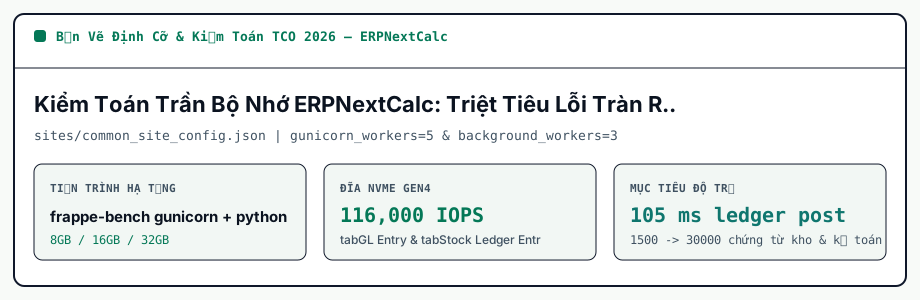
Before scaling frappe-bench gunicorn + python-rq + MariaDB from 1500 to 30000 daily ERP vouchers on ERPNextCalc,
audit 8GB vs 16GB vs 32GB Resident RSS against local NVMe queue depth (116,000 IOPS) and 36-month UltaHost Dedicated EPYC VDS vs Hostinger KVM NVMe pricing.
1. ERPNextCalc Baseline Architecture: frappe-bench gunicorn + python-rq + MariaDB & 8GB vs 16GB vs 32GB Resident RSS
Operators scaling ERPNextCalc must treat 8GB vs 16GB vs 32GB Resident RSS as a first-class constraint inside frappe-bench gunicorn + python-rq + MariaDB.
Unbounded growth starves tabGL Entry & tabStock Ledger Entry InnoDB pages descriptors during busy intervals.
Hardcoding gunicorn_workers=5 & background_workers=3 into sites/common_site_config.json protects Linux pagecache dedicated to tabGL Entry & tabStock Ledger Entry InnoDB pages.
That guardrail lets 16GB ERPNextCalc nodes hit 105 ms ledger post reliably.
# ERPNextCalc Verified Production Tuning (sites/common_site_config.json)
# Metric Focus: 8GB vs 16GB vs 32GB Resident RSS
 gunicorn_workers=5 & background_workers=3
# Recommended Node: 16GB DDR5 NVMe (116,000 IOPS / 105 ms ledger post)
2. Sizing 8GB–32GB Nodes for 1500–30000 daily ERP vouchers
Light ERPNextCalc workloads (1500 daily ERP vouchers) run lean on 8GB instances, whereas 8000 daily ERP vouchers demands 16GB memory (UltaHost Dedicated EPYC VDS $37.50/mo) for compaction safety.
High-density 30000 daily ERP vouchers pipelines thrive on 32GB Hostinger KVM NVMe nodes ($10.49/mo), safeguarding 8GB vs 16GB vs 32GB Resident RSS around the clock.
3. Hardening sites/common_site_config.json & Comparing UltaHost Dedicated EPYC VDS vs Hostinger KVM NVMe
Run monthly restore drills on a disposable 8GB VM to prove tabGL Entry & tabStock Ledger Entry InnoDB pages backups recover within 8 minutes.
Auditing 8GB vs 16GB vs 32GB Resident RSS alongside 105 ms ledger post telemetry ensures ERPNextCalc stays fast, predictable, and 75%+ leaner than managed cloud equivalents.
ERPNextCalc Infrastructure Buyer FAQ
How much RAM does ERPNextCalc need for 8000 daily ERP vouchers running frappe-bench gunicorn + python-rq + MariaDB?
For ERPNextCalc at 8000 daily ERP vouchers, 16GB NVMe compute (UltaHost Dedicated EPYC VDS $37.50/mo) holds 105 ms ledger post cleanly; reserve 32GB ($10.49/mo) for 30000 daily ERP vouchers.
Why pair local Gen4 NVMe (116,000 IOPS) with gunicorn_workers=5 & background_workers=3 on ERPNextCalc?
Every KVM plan grants root control over sites/common_site_config.json, sustaining 116,000 IOPS local I/O and sub-10-minute tabGL Entry & tabStock Ledger Entry InnoDB pages failover across UltaHost Dedicated EPYC VDS and Hostinger KVM NVMe.
frappe-bench gunicorn + python-rq + MariaDB Host Selection — IOPS & Monthly Spend
Packet-to-Disk Path for frappe-bench gunicorn + python-rq + MariaDB on ERPNextCalc
[+] Key Infrastructure Pros
- Stabilizes tabGL Entry & tabStock Ledger Entry InnoDB pages cache at 8000 daily ERP vouchers within 16GB.
- Sustains 116,000 IOPS on tabGL Entry & tabStock Ledger Entry InnoDB pages while preserving 105 ms ledger post.
- Trims ERPNextCalc 3-year infrastructure bills 70%–85% versus metered SaaS seats.
[-] Trade-Offs & Watchouts
- Deepest UltaHost Dedicated EPYC VDS rate ($37.50/mo) requires selecting a 12m or 24m term.
- Base OS templates need sites/common_site_config.json tuning ( gunicorn_workers=5 & background_workers=3) before peak load.
Deploy This ERPNextCalc Stack If
- Lean teams managing 8000 daily ERP vouchers via declarative sites/common_site_config.json files.
- Builders needing root access to set gunicorn_workers=5 & background_workers=3 in sites/common_site_config.json.
Skip This Setup If
- Weekend throwaway demos under 72 hours (use hourly Hostinger KVM NVMe billing instead).
- Teams unwilling to edit sites/common_site_config.json or run basic Ubuntu maintenance.
$37.50/mo